


In the field of CNC machining, CNC milling cutters are among the most important cutting tools. They are widely used on CNC milling machines to create shapes, cut slots, machine flat surfaces, and produce complex components. With the advancement of modern manufacturing technology, CNC milling cutters have become increasingly diverse in terms of materials, designs, and applications, helping improve precision, productivity, and cost efficiency.
This article explains in detail what a CNC milling cutter is, its structure, functions, and the most common types of CNC milling cutters used today, helping you choose the most suitable option for your machining needs.
What Is a CNC Milling Cutter?
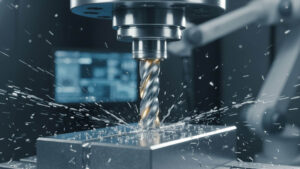
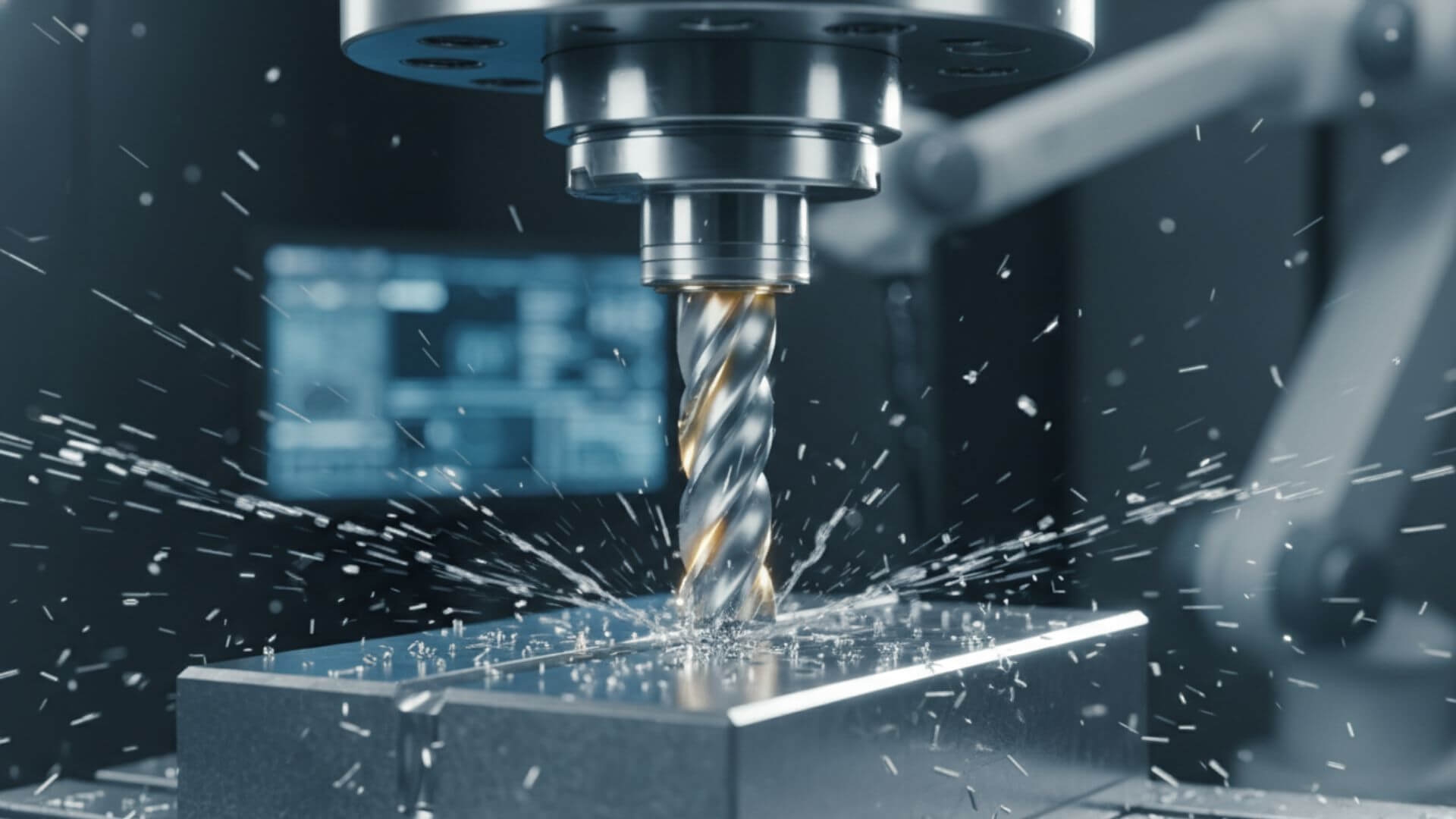
A CNC milling cutter (also known as a CNC end mill) is a rotating cutting tool mounted on the spindle of a CNC milling machine. The tool consists of a shank and cutting edges (flutes) and works by rotating at high speed while moving along a programmed toolpath to remove material from the workpiece.
Unlike manual milling tools, CNC milling cutters are optimized for high-speed machining (HSM), capable of handling high cutting loads, ensuring efficient chip evacuation, and providing long tool life. They are typically made from premium materials such as carbide (cemented carbide) and often coated with TiAlN, AlTiN, or ZrN to improve heat resistance and wear resistance.
Main functions of CNC milling cutters:
- Milling flat surfaces, slots, and 3D contours
- Performing both roughing and finishing operations
- Manufacturing precision components for molds, automotive parts, electronics, and mechanical engineering
- Machining a wide range of materials such as steel, stainless steel, aluminum, titanium, plastics, wood, and composites
Basic Structure of a CNC Milling Cutter
CNC milling cutters (especially end mills) are carefully designed to withstand high cutting forces, ensure effective chip evacuation, and maintain high machining accuracy. Their basic structure includes the following main components:
Shank
The shank is the end portion of the tool used to mount it into the collet, holder, or CNC spindle.
Common shapes include:
- Straight shank
- Weldon shank (with a flat locking surface)
- Morse taper or BT/ISO taper shanks
The shank is usually made from high-strength alloy steel to prevent vibration and wear.
Typical shank diameters range from 3 mm to 32 mm (commonly 6 mm, 8 mm, 10 mm, and 12 mm in Vietnam).
Tool Body (Core)
The body connects the shank to the cutting edges and must withstand significant bending and torsional forces.
It is often designed with a gradually reduced diameter toward the tip to increase rigidity.
Common materials include:
- Solid carbide
- Coated high-speed steel (HSS)
Cutting Edges (Flutes)
This is the most critical part of the tool, directly contacting the workpiece to remove material.
Number of flutes:
2 flutes – ideal for aluminum and wood due to better chip evacuation
3–4 flutes – balanced performance for steel and stainless steel
5–8 flutes – used for finishing and machining harder materials
Helix angle:
Typically 30°–45°
Higher helix angles (45°–60°) are suitable for aluminum to improve chip evacuation
Lower helix angles are better for harder steels to increase durability
Other features include:
Rake face – positive rake for lighter cutting, negative rake for heavy cutting
Relief angle – reduces friction and prevents rubbing
Tool Tip (End)
The tip is the first part that contacts the workpiece.
Common types include:
Flat end – for flat surfaces and square slots
Ball nose – for machining curved 3D surfaces
Corner radius – increases tool life and prevents edge chipping
End Teeth
Many end mills also have cutting edges at the bottom, allowing plunge milling (vertical cutting into the workpiece).
Chip Flutes (Gullet)
Helical grooves between the cutting edges help remove chips efficiently, reducing heat buildup and vibration.
Tool Coating
A thin coating layer (2–5 µm) such as TiAlN, AlTiN, ZrN, or DLC increases heat resistance (up to 800–1200°C), reduces friction, and improves wear resistance.
Thanks to this structure, CNC milling cutters can achieve hardness levels above 90 HRA (carbide) and operate at high cutting speeds (Vc 200–500 m/min depending on material).
Most Common Types of CNC Milling Cutters Today
Below are the most widely used CNC milling cutter types in Vietnam and worldwide.
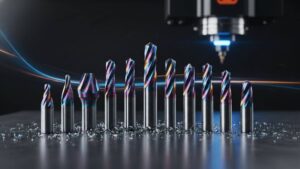
Square End Mill (Flat End Mill)
This is the most common type of CNC milling cutter, featuring a 90° flat cutting edge.
Applications:
- Flat surface milling
- Slot cutting
- Roughing and finishing square-edge profiles
Typical flute counts:
- 2 flutes for aluminum (better chip evacuation)
- 4 flutes for steel and stainless steel
Advantages:
- Highly versatile
- Affordable
- Easy to program
Popular brands include OSG, YG-1, Kennametal, and Sandvik.
Ball Nose End Mill
Ball nose end mills have a hemispherical tip, with the radius equal to half the tool diameter.
Applications:
- Machining curved surfaces
- 3D mold and die machining
- Complex contour finishing
Flute count: Usually 2–4 flutes with high-quality coated carbide
Advantages:
- Produces smooth surface finishes
- Reduces tool marks (stepover lines)
- Ideal for 3D CAM machining
Trend for 2025: ultra-fine carbide ball nose tools for machining titanium and advanced alloys.
Corner Radius End Mill (Bull Nose End Mill)
These tools have a flat tip with a small corner radius (0.1–3 mm).
Applications:
- Machining rounded edges
- Increasing tool life by reducing corner chipping
- Combined roughing and finishing operations
Advantages:
- Combines benefits of flat and ball end mills
- Better resistance to cutting forces
- Commonly used for hardened steel and stainless steel machining.
Face Mill (Indexable Face Mill)
A face mill is a larger tool that holds multiple indexable inserts (3–16 inserts) with cutting angles of 45° or 90°.
Applications:
- High-productivity machining of large flat surfaces
- Rapid roughing operations
Advantages:
- Low insert replacement cost
- Long-term cost efficiency
- Suitable for mass production industries such as automotive and mold manufacturing
- Common insert types include APMT and SEKN, produced by manufacturers such as Sumitomo and Kyocera.
Roughing End Mill
Roughing end mills have serrated or wave-shaped cutting edges designed to break chips into smaller pieces.
Applications:
- Removing large amounts of material quickly
- Roughing operations before finishing
Advantages:
- Reduced vibration
- Improved chip evacuation
- Ideal for rigid CNC machines
Typical specifications:
- 3–5 flutes
- Carbide tools with AlTiN coating
Other Specialized Milling Cutters
Additional specialized tools include:
Aluminum end mills – 2–3 flutes with ZrN coating or uncoated surfaces
Chamfer mills – used for creating 45° or 60° chamfers
Thread mills – used for precise internal and external thread machining
Benefits of Using High-Quality CNC Milling Cutters
High-quality CNC milling cutters from reputable brands such as OSG, Sandvik, Kennametal, and YG-1 offer many advantages compared to standard tools:
High precision and superior surface finish
- Achieve tolerances of ±0.005–0.01 mm
- Smooth surface finishes (Ra 0.4–0.8 µm)
- Reduce the need for manual finishing processes
Higher productivity and cutting speed
- Allow cutting speeds 2–5 times higher than HSS tools
- Reduce machining time by 30–50%
- Ideal for mass production in automotive, mold, and electronics industries
Longer tool life
- Coated carbide tools can last 5–10 times longer than HSS tools
- Reduce tool change frequency
- Lower long-term production costs
Reduced material waste
- Better chip evacuation
- Minimized built-up edge, especially when machining aluminum, stainless steel, or titanium
Reduced vibration and cutting forces
- Balanced tool design
- Low-friction coatings help protect the machine spindle and improve repeatability
Flexible applications
- A single high-quality tool can machine various materials including steel, stainless steel, aluminum, titanium, and composites
- Suitable for 3-axis to 5-axis machining
Overall, investing in high-quality tools can reduce total production costs by 20–40% through improved efficiency and fewer machining errors.
Tips for Selecting and Using CNC Milling Cutters
To achieve optimal performance and avoid damage to the tool, machine, or workpiece, consider the following factors:
Identify the workpiece material
- Aluminum, wood, plastics → 2–3 flutes, high helix angle, ZrN/DLC coating
- Steel and stainless steel → 4–6 flutes with TiAlN/AlTiN coating
- Titanium and hard alloys → fine-grain carbide tools with specialized coatings
Choose the appropriate flute count and tool geometry
- Roughing → 3–5 flutes with flat or large corner radius tips
- Finishing → 4–8 flutes with ball nose or small corner radius
Cutting depth (ap) and radial step-over (ae) should match the cutting length and should not exceed 3–4 times the tool diameter to prevent breakage.
Use proper cutting parameters
Refer to the manufacturer’s catalog for:
- Cutting speed (Vc)
- Feed per tooth (fz)
- Axial and radial depth (ap / ae)
Example:
Steel → Vc 150–250 m/min
fz 0.05–0.15 mm/tooth
Using CAM software such as Fusion 360 or Mastercam helps calculate these parameters accurately.
Cooling and lubrication
Coolant or Minimum Quantity Lubrication (MQL) is essential when using carbide tools to prevent overheating.
For aluminum machining, dry cutting or compressed air may also be used.
Proper tool holding and balancing
Use high-quality ER collets and tighten them with the correct torque.
Always check tool balance, especially for long tools, to avoid spindle vibration.
Maintenance and inspection
Inspect cutting edges regularly using a magnifier or measuring tool
Replace tools when wear exceeds 0.1–0.2 mm
Avoid tool collisions and store tools in a dry environment
Choose reliable brands
Recommended brands include OSG, Kennametal, Sandvik, Mitsubishi, YG-1, and GBTECH, which offer good performance and availability in Vietnam.
Following these guidelines ensures maximum tool performance, longer tool life, and safe machine operation.
Conclusion
CNC milling cutters are truly the “heart” of CNC milling machines. The most common types today—square end mills, ball nose end mills, corner radius end mills, and indexable face mills—are helping Vietnam’s mechanical industry significantly improve productivity.
Choosing the right milling cutter not only enhances product quality but also greatly reduces machining costs.
If you are investing in a CNC workshop or need expert advice on selecting the right milling cutters for your materials and applications, contact Yamaguchi, a trusted supplier of industrial equipment and genuine CNC tools in Vietnam.
Contact us for free consultation and the best pricing:
094 851 9229 – 091 496 3282 (Zalo)